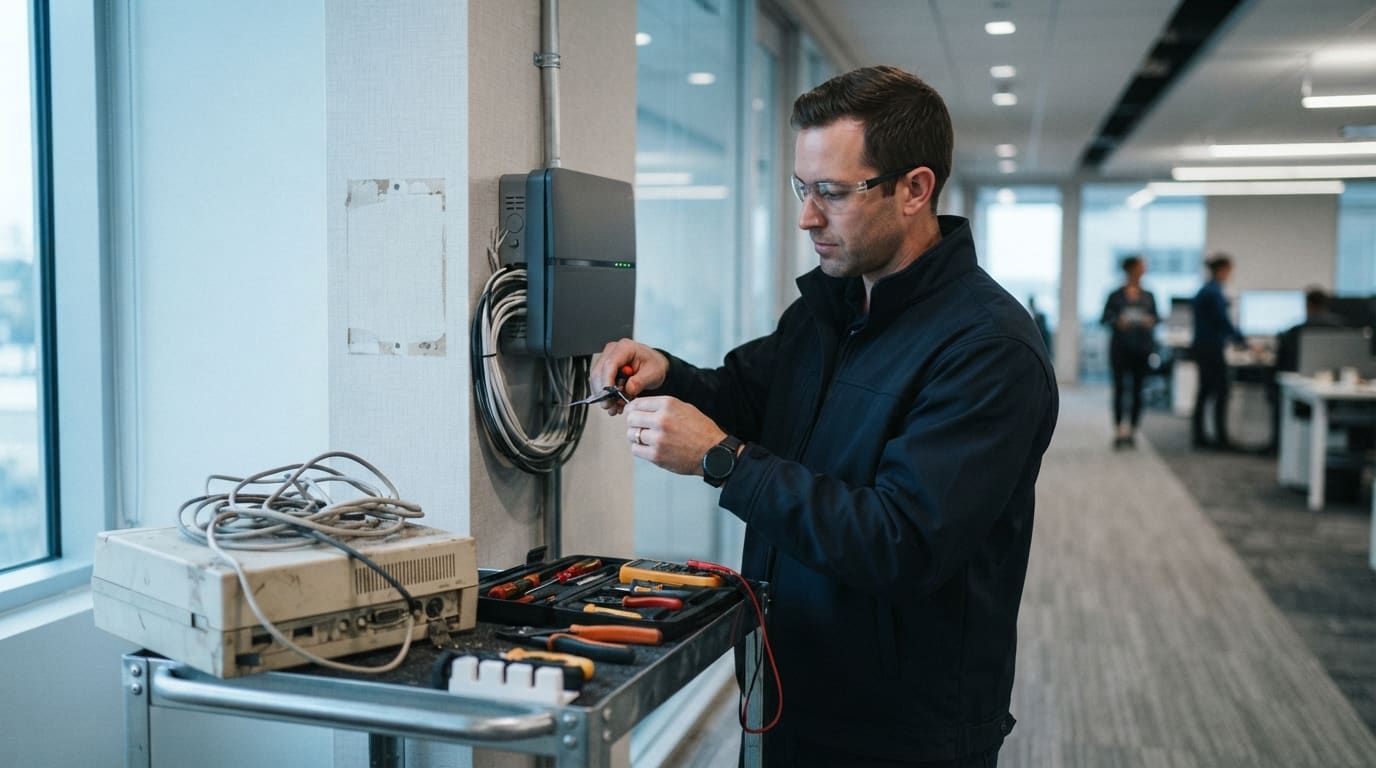

Access control is usually the system businesses feel most locked into. The readers, controllers and door hardware are built into the building, every staff member carries a card, and the only people who know how it’s programmed work for the company that installed it. When that provider stops answering the phone, it can feel like the building belongs to them.
It doesn’t have to. An access control takeover moves administration and support of your existing system to a new integrator, usually without replacing the hardware on the doors. Here’s how it works and where it tends to go wrong.
What an Access Control Takeover Covers
Before anything changes, be clear about exactly what’s moving. On most commercial sites, that’s:
- The management software and server. Where cardholders, access levels and schedules live, and where every door event is logged.
- Controllers and door hardware. Panels, readers, locks, door position sensors and exit buttons.
- The cardholder database. Every staff, visitor and temporary worker credential, plus their access rights.
- Credentials. The cards, fobs or mobile credentials people carry, and the card format they’re programmed with.
- Integrations. Links to alarms, CCTV, intercoms, lifts and fire systems.
- Service and fault response. Who fixes a door that won’t release, and how quickly.
Writing this down for your own site is the simplest way to make sure nothing gets missed in the handover.
Step 1: Audit the System as It Stands
The incoming integrator should assess what’s installed before quoting anything. That means the platform and software version, controller firmware, licensing, the number and condition of doors, how the system is networked, and which integrations are actually working.
The aim is to sort everything into three groups: sound and ready to take over, working but nearing end of support, and failed. On most sites the majority of doors and controllers land in the first group.
Step 2: Recover Admin Access, Licences and Data
This is where access control takeovers stall. To take over a system properly, the new provider needs:
- Full administrator access to the management software
- Any installer or engineering codes for the controllers
- Software licence details and the status of any support agreement
- A current backup of the cardholder database
- Card format and site code details, plus any encryption keys used on the credentials
- As-built drawings or a door schedule, if they exist
Ask for this in writing, early, and check your agreement confirms the system and its data are yours. If something can’t be recovered, an experienced integrator can usually work around it, but it adds time and needs careful planning.
Step 3: Check Credential Compatibility
Credentials are the part most people forget. If your cards use a standard format the new provider can read and enrol, staff keep the cards they already have. If the cards are encrypted with keys only the old provider holds, some or all of them may need to be reissued.
Find this out before the cutover date, not on it. Reissuing cards across a large workforce is very manageable when it’s planned, and very disruptive when it isn’t.
Step 4: Cut Over With Every Door Still Secure
The goal is that nobody notices the changeover happened. In practice that means:
- Keeping doors operating in their normal mode throughout
- Confirming fire egress and fail-safe or fail-secure behaviour on every door before and after
- Testing integrations (alarm arming, CCTV call-ups, lift access) once administration has moved
- Agreeing a clear handover time so there’s never a window where nobody is responsible for a fault
Only once every door, schedule and integration is confirmed working should the old provider step away.
Step 5: Clean Up What’s Built Up
Takeovers almost always uncover easy fixes: cardholders who left years ago but still have access, access levels nobody can explain, outdated firmware, and door schedules that no longer match how the site operates. Tidying these up early tightens security straight away and makes the system much easier to manage.
Hardware that’s genuinely at end of life can then be replaced in stages through a planned system lifecycle upgrade, rather than all at once.
Questions to Ask an Incoming Integrator
- Which access control platforms are they certified on?
- Will they take over your existing controllers and readers, or are they quoting new ones?
- Can your current cards be kept, and if not, why not?
- How will they keep doors and fire egress working during the cutover?
- What fault response times are written into the service agreement?
If the answer to the second question is “replace everything”, get a second opinion first.
Taking Over Your Access Control With Bravis
Our security system takeover service covers access control, CCTV and alarms. We work across commercial access control platforms including Gallagher and Inner Range Integriti and Inception, so existing hardware can usually stay where it is.
For the bigger picture on switching every system on site, see our guide to how a security provider changeover works. If it’s your cameras you’re looking to move, read our guide to a CCTV monitoring takeover.
If you’re ready to take back control of your doors, get in touch and we’ll start with an assessment of what’s already installed.