
For most businesses, access control starts as a key problem. Someone leaves without handing their key back, a master key goes missing, or the locksmith bill for rekeying the building lands for the second time in a year. Access control fixes that, but the bigger benefits only show up once it’s running.
This guide is for businesses with one or a few sites and a handful to a few dozen controlled doors: offices, warehouses, workshops, clinics and retail. If you’re scoping a larger multi-door commercial building and comparing enterprise platforms, our guide to commercial access control systems in Brisbane goes deeper.
What Is a Business Access Control System?
An access control system replaces keys with credentials, usually cards, fobs, a mobile phone or a PIN. A reader at each controlled door checks the credential, a controller decides whether that person is allowed through at that time, and the software logs the result. You manage who can go where, and when, from one place instead of a key register.
The Benefits for a Small or Mid-Sized Business
No more rekeying when staff leave
When someone leaves, their card is cancelled in seconds. There’s nothing to collect, copy or change. A lost fob stops being a security problem as soon as it’s switched off, which is the single biggest saving most small businesses notice.
Access that matches roles and shifts
Not everyone needs every door. Office staff get the front door during business hours, the warehouse team gets the dock door for their shift, and only managers get the cash office or stock room. Early starts and late finishes are handled automatically, so nobody has to stay back just to lock up.
A record of who came and went
Every entry, and every refused attempt, is logged against a named person. When stock goes missing or there’s a dispute about who was on site, you have an answer in minutes rather than a guess.
Protecting the rooms that matter
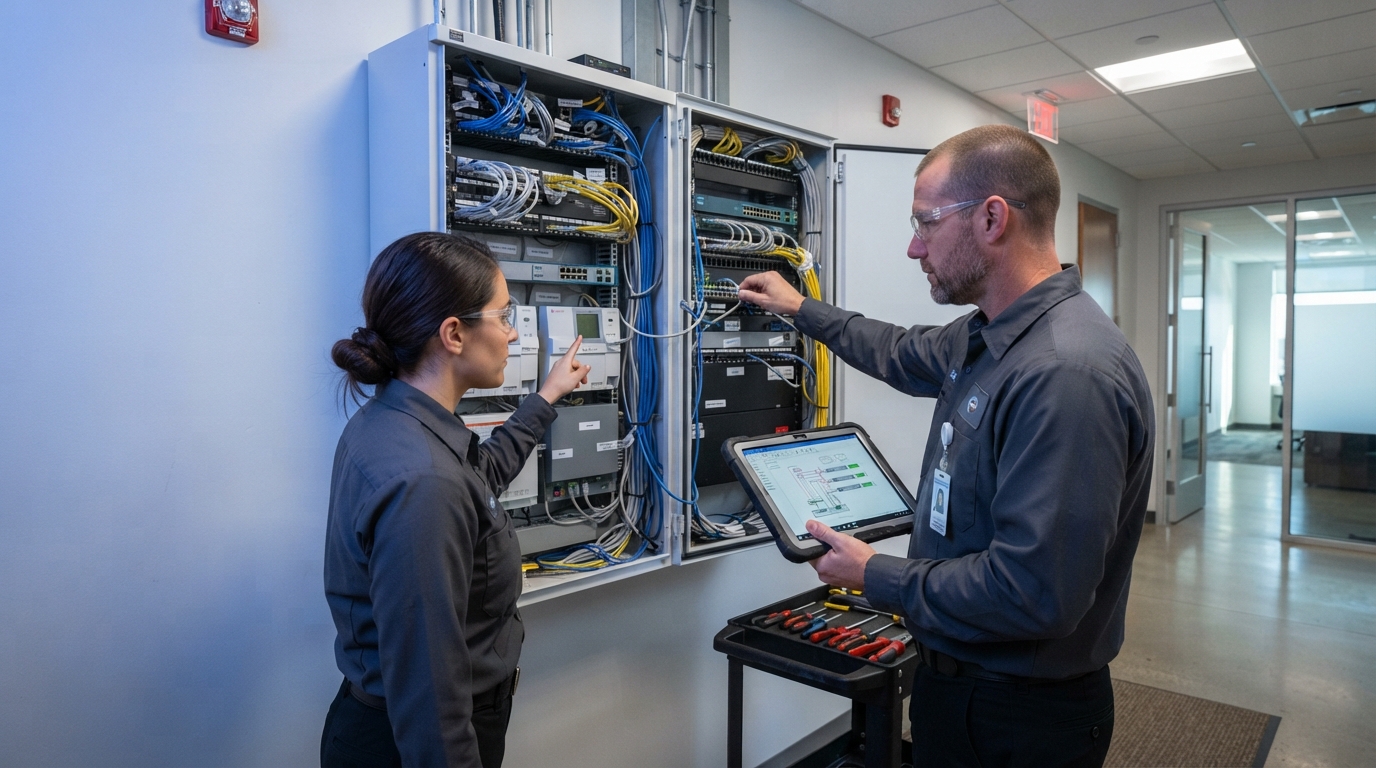
Most businesses have one or two rooms where a mistake is expensive: the server or comms room, a stock cage, a dispensary, a records room. Access control lets you lock those down harder than the rest of the building. If yours is a server room, our guide to server room access control covers it in detail.
Easier for staff and visitors
Staff tap in rather than juggling keys. Visitors, cleaners and trades can be given access for a set day and time window that expires by itself. Pair the front door with a video intercom and reception can let people in without leaving the desk.
It works with your cameras and alarms
On a properly integrated system, a door forced open brings up footage from the nearest camera, and the alarm can be armed or disarmed with the same card staff use to get in. That turns three separate systems into one picture of what’s happening on site.
It grows with the business
Start with the front door and the stock room, then add doors, a second site or new credential types later on the same platform. That’s the main reason to choose a business-grade system over a consumer smart lock, which tends to be replaced as soon as the business outgrows it.
Is Access Control Worth It for a Small Business?
Access control usually pays for itself when any of these apply:
- More than a handful of people hold keys
- Staff turnover is regular, or you use casuals and temps
- People need access outside business hours
- You have stock, cash, data or equipment worth protecting from the inside as well as the outside
- Your insurer, clients or auditors ask how physical access is controlled
The cost depends mainly on the number of doors, the door hardware each one needs, cabling, the type of credential and whether the software runs on site or in the cloud. Starting with one or two doors on a platform that can scale is often the smartest first step.
Choosing a Platform Without Overbuying
Small and mid-sized businesses don’t need the same platform as a government campus, but they do need one that’s supported and can grow. Platforms like Integriti and Inception suit most business sites, SALTO works well where doors are hard to cable, and Gallagher is there for higher-security sites. Every controlled door also has to meet fire egress requirements, which a good integrator checks door by door. Our Brisbane commercial access control guide walks through those platform and compliance choices.
Already Have a System?
If you’ve inherited access control from a previous tenant or a provider who no longer answers the phone, you may not need to replace it. A security system takeover can often bring existing hardware under proper support and add the doors you’re missing.
Talk to Bravis About Access Control for Your Business
Bravis Security is a Capalaba-based, Queensland-licensed integrator, certified across Gallagher and Inner Range, designing access control for businesses from single-tenancy retail fitouts through to multi-site operations. If you’re weighing up access control for your business, get in touch and we’ll recommend a system sized to what you need now, with room to grow.